-
10 Ways to Create More Musical Phrases
There comes a moment in every musician’s practice routine when they stare at a piece of music and think… “I have no idea how I want to play this!” Practicing the nuts and bolts of a piece (technique, rhythm, instrumental fundamentals) is relatively straightforward (most of the time, anyways), but musical interpretation opens up an entirely new realm of possibility. Phrasing choices and musical interpretation of a piece will depend greatly on the genre, style, era, and a multitude of other factors. Here are a few suggestions to help you experiment and create a more compelling phrase: Identify the phrases. It’s hard to build a better phrase if you don’t…
-
Protected: Travel Log 2 – Shearing Sheep in Sjeyndir
There is no excerpt because this is a protected post.
-
Beginning Clarinet Milestones Checklist
Whether you’re just starting out on your clarinet journey or are teaching someone who is, there are many milestones you will encounter during the first year of playing! Although the clarinet is quite a popular instrument, there certainly are quite a few fundamentals, pieces of equipment, and countless other details to consider! This is why I created this checklist – to help both beginning clarinetists and their teachers stay organized and make sure you’re not missing any important musical milestones. Note: I have organized each category in a progressive sequence, but you should customize your learning/teaching strategy for each student to ensure they have optimal progress. (Want a downloadable version…
-
Equipment List for Beginning Clarinetists
This post originally appeared on the Jellynote blog. Jellynote is a great website to find sheet music, articles, and other resources for musicians. I’ve enjoyed exploring their website using Jellynote Premium (which was generously gifted to me) the past few months, and I hope you’ll check out their website! Congratulations on beginning your journey to learn the clarinet! I might be a bit biased, but I think it’s the best instrument, and I’m so excited that you want to learn to play the clarinet. Before you start playing clarinet, you should check to make sure that you have everything you need so you can focus on music-making (instead of struggling to find a mouthpiece or…
-
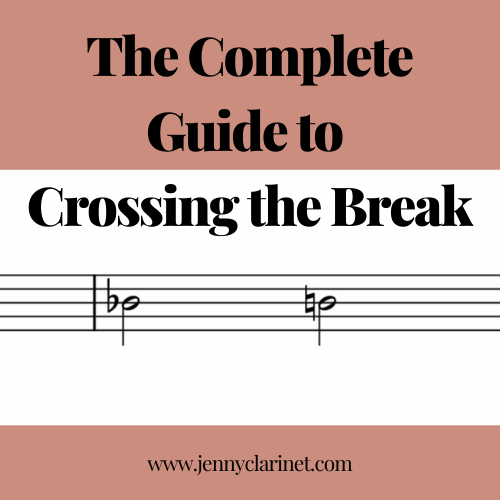
The Complete Guide to Crossing the Break on the Clarinet
One of the most difficult fundamentals on the clarinet is crossing the break (which I abbreviate CTB). For such a small interval, it can certainly pose a multitude of problems. Here’s everything players and teachers should know to cross the break with confidence! What is the break? The break is the transition from the chalumeau (low) register to the clarion (middle) register. (There is also the upper break, when you transition from the clarion to the altissimo register, but we’ll save that for another article.) When clarinetists first cross the break, they are probably moving from a throat tone (open G, G#/Ab, A, or Bb) to the middle of the…
-
Quick Fix Friday: Maintain the Momentum on Long Notes
Happy Friday! Another week, another quick fix! You might think that long notes are easier to play – after some technical fireworks, you can hang out on a few whole notes and relax. If you’re guilty of doing this, you’re missing out on some nice phrasing opportunities. Let’s talk about my theory of musical magnetism for a second. I believe that all notes in music are either moving away from previous notes or moving towards upcoming notes. I think that notes either repel or attract each other, much like magnets. What does this have to do with clarinet? I hear many students who flatline or lose the momentum on longer…
-
Reed Advice for Beginning Clarinetists
This post originally appeared on the Jellynote blog. Jellynote is a great website to find sheet music, articles, and other resources for musicians. I’ve enjoyed exploring their website using Jellynote Premium (which was generously gifted to me) the past few months, and I hope you’ll check out their website! The clarinet is a wonderful instrument, but it certainly does require several pieces of equipment, including reeds! For beginning clarinetists, selecting and caring for these reeds can be confusing, so here’s everything you need to know: Learn the lingo: Strength. Reed strength measures the flexibility of the cane, and this is typically measures in half or quarter strengths (generally ranging from…
-
Quick Fix Friday: Play Between the Notes
Happy Friday! This week’s quick fix will help you direct your air while creating more compelling musical interpretations. If you’ve ever noticed that your sound is choppy or disjunct, it’s probably because you are slowing or stopping your air flow when you change notes. This is especially common if you are articulating notes, as the tongue can often interrupt the air flow if you aren’t careful. The quick fix? Play between the notes by focusing on creating a steady air column. Imagine this: you are riding your bike up a steep hill. You need a bit more momentum to make it to the top. Now, translate the momentum in this…
-
Clarinet History Story Time: When Heinrich Bärmann was questioned by the police
When clarinetists think of Heinrich Bärmann, the famous Weber clarinet concerti usually come to mind. But did you know that he once had an unfortunate encounter with a Venetian canal, a petty concert organizer, and the Venice Police? This tale is recounted in the English translation of Louis Spohr’s autobiography. This entry is from October 12, 1816, and this story was shared by the German musician Aiblinger who had been living in Venice for the past sixteen years: “Count Herizo, a very rich nobleman, who, during the winter, gives a concert at his house every week, to which he frequently invites as many as two hundred persons, besought Bärmann, through a third…
-
Quick Fix Friday: Play with a slurred sound
Happy Friday! One of the most common queries I receive is how to improve clarinet articulation. Many people focus so much on the tongue that they neglect the air. I truly believe that 90% of clarinet problems can be traced back to air, and articulation is no exception. (Don’t get me wrong – there are certainly issues that can arise with the tongue and other factors, but we’ll save those for another blog post. You can also check out my complete guide to clarinet articulation to learn more about improving your tonguing.) On to this week’s quick fix – play with a slurred sound! When I tell my students to…